Prototype Sleeves: Custom Precision-Machined Components
Developing new equipment requires components that meet exact design specifications from the first iteration. SleeveMFG provides precision-machined prototype sleeves for engineers, OEMs, and MRO service providers who require tight tolerances, specific material properties, and geometric accuracy before committing to mass production.
- Tolerances
- 0.005 mm
- Surface Finish
- Ra 0.2 μm
- Lead Time
- Fast
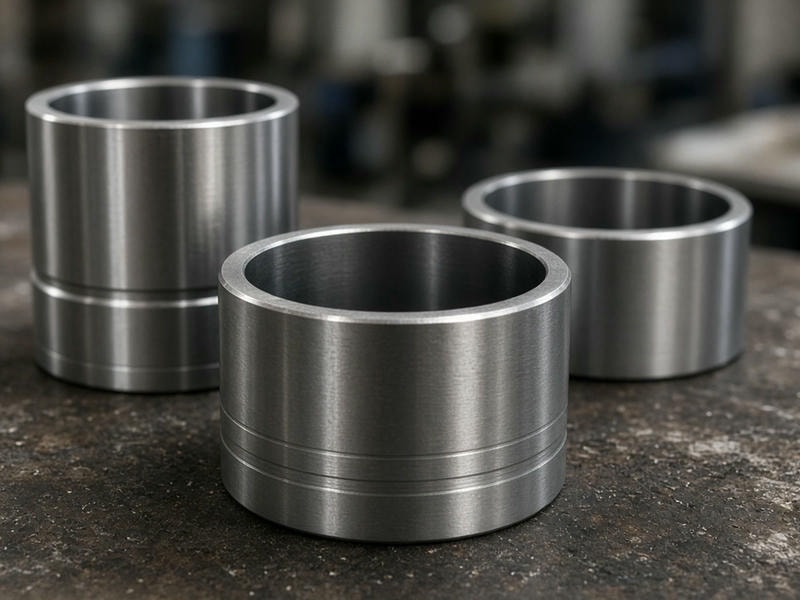
Precision Prototype Sleeve Manufacturing
In the prototype phase, the primary objective is validating the design, material selection, and fitment. SleeveMFG operates a specialized facility in Dongguan, China, configured for the machining of custom sleeves, bushings, and spacers. Unlike high-volume shops that prioritize raw speed over precision, our workflow is optimized for the adjustments and rigorous inspection required during the development process.
We accept drawings in PDF, STEP, IGES, and DXF formats. Our engineering team reviews each file to identify potential manufacturing challenges—such as thin-wall distortion or complex internal profiles—before the machining begins, ensuring the prototype functions as intended in your assembly.
Manufacturing Capabilities
SleeveMFG utilizes a comprehensive suite of machinery to produce prototype sleeves that mirror the quality of final production parts.
CNC Turning & Milling
Capable of handling complex geometries, including shoulders, flanges, keyways, and cross-drilled holes.
Precision Grinding
OD/ID grinding and centerless grinding to meet critical tolerances for bearing fits and seal surfaces.
Dimensional Control
Tight ID/OD fits (H6/H7 or h6/h7) with concentricity, roundness, and cylindricity controlled to 0.005 – 0.01 mm.
Surface Finish
Specialized finishing processes achieve surface roughness down to Ra 0.2 μm for dynamic sealing applications.
Threading & Profiling
Metric, UNC, UNF, and NPT threads, along with custom internal and external profiles.
Engineering Support
Design-for-manufacturing feedback to optimize your sleeve for cost and performance during the RFQ process.
Material Selection for Prototyping
The performance of a prototype sleeve depends on the material chosen for the application. We maintain a diverse inventory of industrial metals and can source specialty materials based on your engineering requirements.
For prototypes requiring specific surface properties, we coordinate secondary operations including heat treatment (quenching, tempering, nitriding, induction hardening) and surface coatings (hard chrome, electroless nickel, PVD/DLC) to ensure the component meets your environment's wear and corrosion requirements.
Stainless Steel
304 / 316 / 316L / 17-4PH / 15-5PH / 420
Carbon & Alloy Steel
1018 / 1045 / 4140 / 4340 / 42CrMo
Tool & Bearing Steel
52100 / GCr15 / D2 / A2
Non-Ferrous
Aluminum (6061, 7075), Brass, Bronze, Aluminum Bronze
High-Performance Alloys
Inconel / Monel / Hastelloy
Quality Control and Inspection
Every prototype sleeve undergoes a rigorous inspection protocol to verify compliance with your drawings. Our quality department utilizes a range of calibrated equipment to document the physical characteristics of your parts.
We provide inspection reports with prototype orders, allowing your team to validate dimensions against the engineering specifications before finalizing the design for mass production.
CMM & Profile Projectors
For complex geometric verification.
Surface Roughness Testers
To confirm finish requirements.
Bore & Micrometer Gauges
For accurate ID/OD measurement.
Hardness Testing
To verify heat treatment results.
Scaling from Prototype to Production
SleeveMFG is structured to support the transition from a single prototype to low-volume batches and eventually full-scale production. By keeping your manufacturing data, tooling setups, and process parameters on file, we ensure consistency across every order.
If a design change is required after testing your prototype, we update the machining programs and manufacturing documentation immediately. This continuity reduces the time and cost associated with sourcing new suppliers as your project moves through its development lifecycle.
-
1
Prototype Run
Validate design, material, and fitment with a single or small-batch order.
-
2
Design Iteration
Update machining programs based on field test results.
-
3
Low-Volume Batches
Bridge quantities for pilot deployment and qualification.
-
4
Full-Scale Production
Transition to volume manufacturing with retained tooling data.
Selecting the Right Sleeve for Your Application
Choosing the correct sleeve involves balancing material properties, tolerance requirements, and the operating environment. When submitting your prototype specifications, consider the following factors to ensure optimal performance and manufacturability.
Our team can offer design-for-manufacturing (DFM) feedback to optimize your sleeve for cost and performance if requested during the RFQ process.
-
Fitment
Will the sleeve be a press fit, slip fit, or shrink fit? Specify your desired tolerance class.
-
Environment
Will the component be exposed to high heat, corrosive fluids, or high-load conditions? This dictates material and coating choices.
-
Dynamic vs. Static
Sleeves used for mechanical seals or shaft protection require higher surface finish and roundness standards than simple spacer sleeves.
-
Geometric Constraints
Consider wall thickness; parts thinner than 0.5 mm require specialized workholding to prevent deformation.
Request a Quote for Your Prototype
SleeveMFG provides rapid, accurate quoting for custom prototype sleeves. Send your engineering drawings or 3D models to begin your project. Please include the following details in your inquiry to receive the most accurate quote.
- Material specification
- Quantity (for prototype and estimated production runs)
- Tolerance requirements
- Surface treatment or heat treatment specifications
- Required delivery timeline
SleeveMFG
Email: info@sleevemfg.com
Phone: